Which Factories Must Install CEMS? Thai Law & POMS Reporting
Which Factories Must Install CEMS? Thai Law and Reporting into the POMS System
Before a plant requests a quote or designs an emission monitoring system, the first question it must answer clearly is whether it is a factory that must install CEMS under the law. Getting this wrong is expensive both ways: assuming you are out of scope when you are not exposes you to orders and penalties, while rushing to invest when it is not yet required wastes budget. This article helps you understand the legal framework and reporting duties systematically. If you are not yet familiar with the basics of the system, read What is CEMS and its 5 core components alongside this piece.
Where the Obligation Comes From
In Thailand, the duty to install CEMS generally arises from two main sources. The first is Ministry of Industry notifications that require certain categories or sizes of factories to install continuous stack emission monitoring equipment and report the results to the Department of Industrial Works (DIW). The second is conditions attached to a project's Environmental Impact Assessment (EIA) or EHIA report, which may require CEMS even when the factory category itself is not yet covered by a general notification. Many plants therefore acquire this duty through their EIA conditions rather than directly from a factory-category list, which is why reviewing your own project's permit documents matters as much as reading the notifications.
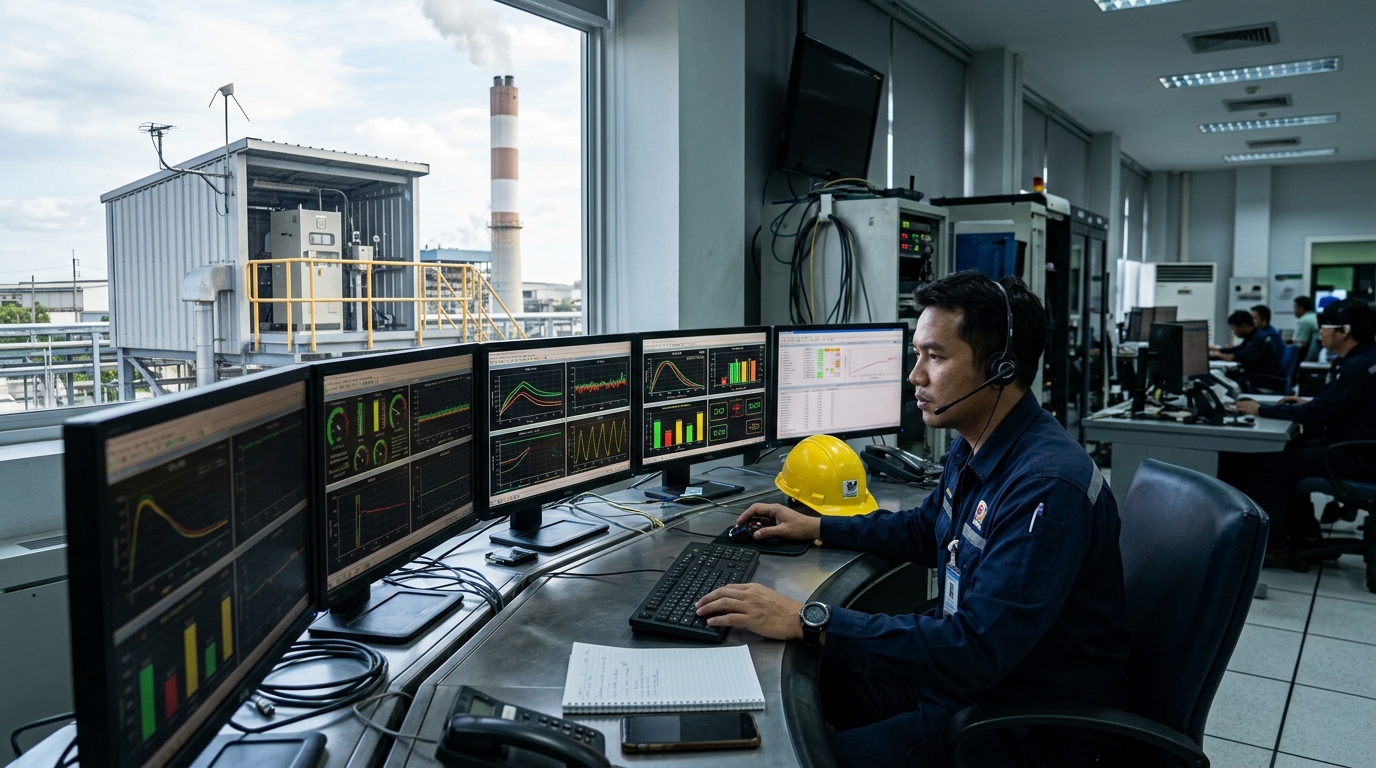
Which Factories Are Typically in Scope
Although the details depend on the notification in force at the time, the factories most frequently found to require CEMS are large air-pollution sources, including:
- Power plants and plants with large boilers, especially those fired with coal, biomass, or heavy fuel oil.
- Oil refineries and petrochemical plants with furnaces and continuous combustion processes.
- Cement plants with kilns that emit high volumes of dust and gases.
- Steel and metal plants with smelting and high-temperature furnaces.
- Waste and refuse incinerators, for both municipal and industrial waste.
Being in scope does not depend on the factory-category name alone; it is usually tied to production capacity, fuel type, and emission volume as well. Two otherwise similar plants may carry different obligations if their size and fuel differ.
Which Parameters Must Be Measured
Once you confirm you are in scope, the parameters you must measure are set by your process type and fuel. They typically cover total particulate matter (TSP) or opacity, sulfur dioxide (SO2), oxides of nitrogen (NOx), carbon monoxide (CO), and oxygen (O2) as a reference gas used to normalize concentration readings. Some processes require additional parameters such as hydrogen chloride (HCl) or volatile organic compounds, plus gas flow rate and temperature to calculate the true emission rate. Defining this parameter list correctly from the outset is the heart of system design, because it determines both the analyzer technology and the budget for the entire project.
The Duty to Report into the DIW's POMS System
Installing CEMS does not end at measurement. Plants also have a duty to transmit data continuously into the DIW's POMS (Pollution Online Monitoring System) so authorities can track emissions in real time. This means the CEMS must come with a Data Acquisition and Handling System (DAHS) that reliably connects and sends data in the format and at the frequency the department requires. A failure to transmit, gaps in the data, or data whose validity cannot be proven are all compliance risksjust as much as an exceedance of the emission limit itself. Plants should therefore treat POMS connectivity as part of the specification from the start, not as an afterthought. For a deeper look at the reporting steps, see our article on reporting CEMS data to the DIW.
Conclusion: Assess Before You Invest
Answering clearly whether your plant must install CEMS should consider factory category and size, fuel type, EIA/EHIA conditions, and the latest notification all together, because the criteria and factory lists are revised periodically. Assessing this with an environmental consultant and against your own project's permit documents gives the most accurate answer. Once you confirm you are in scope, the next step is choosing the right system, which you can read about in our guide to choosing the right CEMS for your plant.
ASE Thailand's engineering team can help assess whether your plant must install CEMS, and design a system and POMS connection that meets the law. Contact us for an initial consultation.


