CEMS Maintenance: A QA/QC Guide from Daily Cal to RATA
Keeping CEMS Data Valid All Year: A QA/QC Guide from Daily Calibration to RATA
Many plants believe that once the emission monitoring system is installed and commissioned, the job is done. In reality, the day the system goes live is the day the real duty beginsbecause what the law and the Department of Industrial Works care about is not merely whether you own the equipment, but whether the data sent into the POMS system is accurate and continuously complete. Good CEMS maintenance is therefore measured not by whether the unit powers on, but by data availability throughout the year. This article lays out a maintenance and QA/QC plan by cycle that you can actually use.
Why "Data Availability" Is the Right Metric
Data that is missing, distorted, or cannot be proven valid is a compliance risk equal to exceeding an emission limit. If an analyzer drifts away from the true value without being checked, or the system stops for hours with no backup data, those periods become gaps in the report. Good maintenance therefore has a clear goal: keep data quality high and its completeness as close to full as possible. That is achieved by planning work in cycles, not by waiting for a problem and then fixing it.
Daily Tasks: Check Zero and Span Drift
The heart of daily QA/QC is checking the drift of the zero and span points. Most modern CEMS perform an automatic daily calibration with reference gas and log how far the reading deviates from the true value. If the drift stays within the acceptable limit, the data is used normally; if it exceeds the limit, a calibration correction must be made and the event logged before that period's data is accepted. The team should review the daily drift report and set alerts so anomalies are caught before they accumulate into a long stretch of unusable data.
Monthly Tasks: Care for the Sample Path
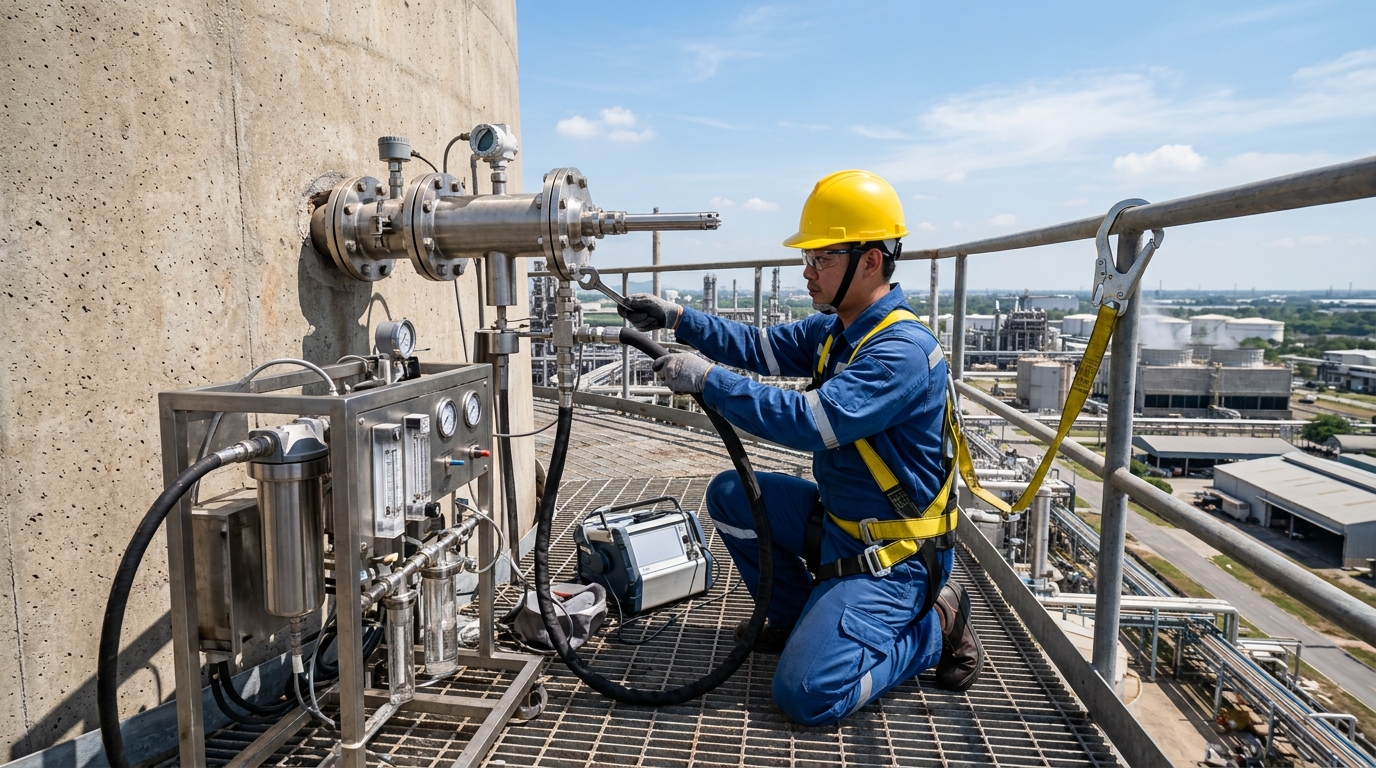
Most problems in an extractive system lie not in the analyzer but in the sample path. Monthly work therefore focuses on replacing or cleaning filters, checking that the heated line holds a stable temperature, verifying that the gas cooler and condensate drainage work correctly, and checking the system for leaks. If a filter clogs or a leak develops, the readings will be wrong even when the analyzer itself is fine. Maintaining the sample path regularly is the most effective way to prevent problems at their source.
Quarterly and Semi-Annual Tasks: Deeper Checks and CGA
On longer cycles, deeper checks are warranted, such as a multi-point cylinder gas audit (CGA) to confirm the analyzer still responds linearly across its measurement range, inspection and replacement of consumable parts with a limited life such as pumps, peristaltic tubing, and gas cooler components, and verification that calibration gases are within their expiry and stored correctly. This cycle bridges daily care and the big annual test, ensuring that when RATA arrives, the system is in condition to pass.
Annual Tasks: RATA and Accuracy Testing
The most important point on the QA/QC calendar is the Relative Accuracy Test Audit (RATA), which compares the CEMS readings against values measured by a standard reference method performed by a competent tester. If the result is within the limit, it confirms the system is still reliable and that a full year of data can be trusted. RATA is therefore not a formality but a gate proving that your year-round care actually worked. Plants that maintain their system well all year enter RATA with confidence, whereas those that neglect it often discover problems on test day and must scramble to fix them. Preparing in advance and keeping systematic maintenance records all year is the key to passing RATA smoothly.
Preventive Maintenance Beats Waiting for Failure
The principle behind all of this is preventive maintenance. Replacing parts by their service life before they fail, checking drift before it escalates, and keeping reference gases and critical spares stocked locally are all cheaper than waiting for the system to crash and then repairing itbecause every hour the system is down is data lost from the report. A service contract with a clearly defined response time from experts gives the plant confidence that when a problem occurs, someone can fix it before data goes missing for long. If you are weighing this cost, read our breakdown of CAPEX and OPEX in what drives CEMS price.
Conclusion
Good CEMS maintenance is a QA/QC plan organized by cyclefrom daily drift checks and monthly sample-path care to quarterly deep checks and the annual RATA. The goal is not merely to keep the unit running, but to keep the data accurate and complete enough to pass audits all year.
ASE Thailand's engineering team provides end-to-end CEMS maintenancefrom preventive maintenance plans and the supply of calibration gases and spares to RATA readiness. Contact us to design a care plan that fits your plant.


