What Drives CEMS Price? A Practical Budgeting Guide
What Drives CEMS Price? A Practical Guide to Budgeting a Continuous Emission Monitoring System
One of the first questions every plant asks when investing in an emission monitoring system is, "How much does CEMS cost?" The honest answer is that there is no single standard number that fits every plant, because the price is the sum of the specification you actually needmuch like asking "how much does a car cost," where the answer depends on the model, size, and options. More useful than a floating figure is understanding what drives the price, so you can budget realistically and compare quotes from several vendors fairly. This article breaks those factors down one by one.
Factor 1: The Number and Type of Parameters
The single biggest price driver is the number of parameters the law requires your plant to measure. A plant that only needs SO2, NOx, CO, and reference O2 will cost less than one that must also add particulates (TSP), HCl, and flow rate, because each parameter may require a different analyzer or measurement principle. Measuring dust by opacity or light-scattering is a different device from a gas analyzer. The longer the parameter list, the higher the total system price. This is why confirming the correct parameter list from the outset matters so muchit defines the cost structure of the whole project.
Factor 2: Technology and Site Conditions
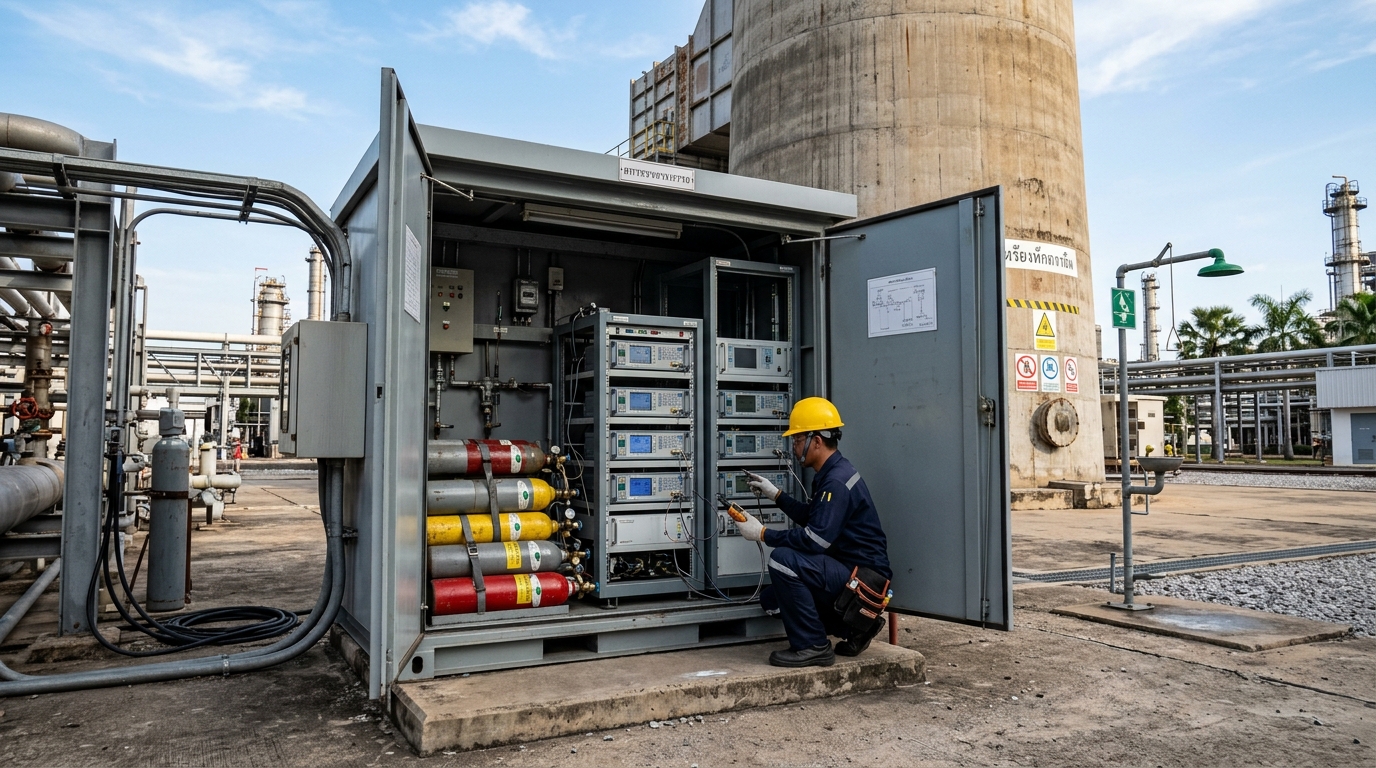
The choice between extractive and in-situ systems significantly affects price. An extractive system, which draws a gas sample down and conditions it before measurement, usually needs a heated sample line, a gas cooler, and a temperature-controlled analyzer shelter, whereas an in-situ system that measures at the stack can reduce sample-line complexity. Site conditions matter just as much: a stack with wet, dusty, or corrosive gas demands more complex and costly sample conditioning than one with dry, clean gas. The distance from stack to analyzer shelter, the height of the installation point, and the need to build a new platform or power supply all add to the installation price.
Factor 3: Installation, POMS Connection, and Commissioning
A CEMS price is not just the equipmentit also includes the on-site engineering and installation: the structural work to mount the probe and shelter, the power and signal wiring, the Data Acquisition and Handling System (DAHS), and the connection that transmits data into the DIW's POMS system. Then come commissioning and testing to prove the system measures correctly before going live. This portion varies greatly with the difficulty of the site, and it is exactly what a cheap-looking quote often omits or under-specifiesmaking it appear cheaper while leaving out essential work.
Factor 4: The Annual OPEX That Is Often Forgotten
The most common mistake in evaluating price is looking only at the purchase cost (CAPEX) and forgetting the annual operating cost (OPEX) that stays with the plant for many years. This group includes calibration gas that must be replaced on a cycle, consumable spares such as filters, pumps, and gas cooler parts, planned maintenance service, and annual accuracy testing such as RATAplus the risk of downtime and penalties if data goes missing. When you combine CAPEX and OPEX into a Total Cost of Ownership (TCO) over the system's life, you see the true cost, and often a system that is cheaper to buy on day one turns out to have a higher long-term TCO if it is designed to consume more maintenance.
How to Compare Quotes Fairly
When you receive quotes from several vendors, the key is comparing them on the same scope of work. Check whether each includes the same parameters, the same installation, POMS connection, commissioning, and annual service contract. The cheapest-looking quote may simply have dropped some work, not offer better value. Asking vendors to itemize CAPEX and OPEX clearly, and to state their breakdown response time and local spare-part availability, lets you decide on complete information. For a deeper approach to vendor evaluation and TCO, read our guide to choosing the right CEMS for your plant.
Conclusion
CEMS price is the sum of the number of parameters, the technology, site conditions, installation, and annual operating cost. Accurate budgeting therefore starts with confirming the specification your plant truly needs, then looking at lifetime cost rather than just the sticker price on day one.
ASE Thailand's engineering team can assess your plant's specific needs and prepare a quote that separates CAPEX and OPEX transparently, so you can compare and decide with confidence. Contact us for an initial assessment.


