Gas Sensor and Gas Detector Innovations: The Heart of Industrial Safety
In the working environments of large-scale industries such as oil refineries, petrochemical plants, power plants, and offshore drilling platforms, safety is the highest engineering standard that cannot be compromised. One of the most dangerous threats is a gas leak, which is often invisible to the naked eye and odorless. Whether it is Combustible Gas, Toxic Gas, or Asphyxiant Gas, detecting these anomalies at an early stage is a matter of life and death. The innovations acting as the frontline defense to protect engineers' lives and massive infrastructure investments are highly accurate gas sensor and gas detector technologies.
Understanding the Difference Between Gas Sensors and Gas Detectors
Although these two terms are often used interchangeably in the industrial sector, in Instrumentation Engineering, they have distinct definitions and functions.
- 1. Gas Sensor: A gas sensor is the core component that directly interacts with the environment. Its function is to detect the presence and measure the concentration level of target gases through chemical or physical reactions. It then converts these interactions into an electrical signal. The sensor acts like a highly sensitive sensory organ and must be protected from harsh environmental conditions.
- 2. Gas Detector: A gas detector is a complete unit that houses the gas sensor along with a processing circuit board (transmitter), a digital display screen, and an alarm system. Its primary role is to receive the electrical signal from the sensor, amplify it, and convert it into human-readable values, such as Volume Percentage (%Vol), Parts Per Million (ppm), or Percentage of the Lower Explosive Limit (%LEL). It also transmits data via industrial communication protocols to integrate with the plant's control system.
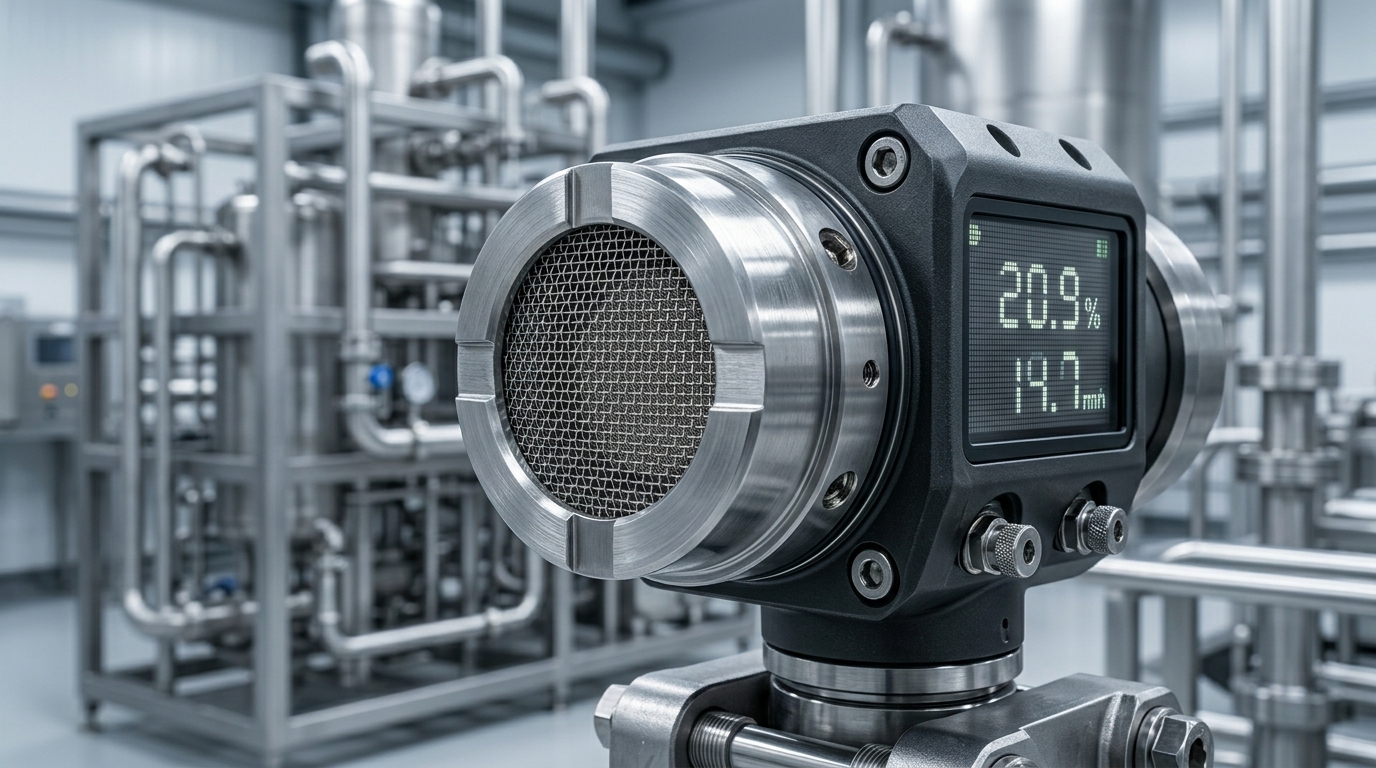
Gas Sensor Technologies Designed for Advanced Engineering
Selecting the right gas sensor must align with the type of gas and the specific industrial environment. Globally recognized technologies include:
- Electrochemical Sensor: Widely used for detecting toxic gases like Hydrogen Sulfide (H2S), Carbon Monoxide (CO), and Chlorine (Cl2). The working principle relies on oxidation and reduction reactions that occur when the target gas permeates through a membrane into an electrolyte solution, creating an electrical current directly proportional to the gas concentration. It offers high precision and a rapid response time.
- Catalytic Bead Sensor (Pellistor): Designed to detect combustible gases, this relies on catalytic combustion on a heating coil arranged in a Wheatstone Bridge circuit. When combustible gas contacts the sensor, it burns, raising the temperature and altering the electrical resistance. This technology is highly durable and cost-effective.
- Non-Dispersive Infrared (NDIR) Sensor: A high-end sensor operating on the principle of infrared light absorption by gas molecules. It is commonly used to measure Carbon Dioxide (CO2) and Hydrocarbons. Its outstanding advantages are that it does not require oxygen to operate and is immune to sensor poisoning from toxic substances.
Integrating Gas Detectors into System Integration
In the Industry 4.0 era, standalone gas detectors cannot provide maximum safety. System Integrator engineers must integrate these devices into the plant's infrastructure. Signals from field devices are transmitted through communication protocols such as 4-20 mA HART, Modbus RTU, or Foundation Fieldbus into a Safety Instrumented System (SIS) or Distributed Control System (DCS).
When a gas detector detects gas concentrations reaching a critical Set Point, the integrated system triggers automated processes (Process Automation). This may include activating emergency ventilation systems, initiating an Emergency Shutdown (ESD) of process valves, and broadcasting plant-wide alarms. This seamless coordination helps prevent disasters before they escalate.
Installation Standards and Maintaining Accuracy
The installation location of a gas detector must be calculated according to Fluid Dynamics engineering principles, considering the target gas's density relative to air. Gases heavier than air, like H2S, require devices mounted near the ground, while lighter gases, like Methane, should have devices mounted higher up. Furthermore, all equipment must be certified with Explosion Proof or Intrinsically Safe standards corresponding to the Hazardous Area Classification, such as ATEX or IECEx.
To ensure consistent device accuracy, routine Calibration and Bump Tests at intervals specified by the manufacturer are vital Preventive Maintenance procedures that operators and environmental engineers must prioritize.
Managing industrial gas safety systems is not just about procuring equipment; it's about designing a flawless engineering system. For plants looking to elevate safety and comply with international standards, consulting System Integration experts and selecting state-of-the-art gas detectors tailored to the production process will build a robust shield, ensuring the sustainable safety of the industry, its personnel, and the environment.


