Elevating Industrial Quality Control with Gas Chromatography Technology
In an era where petrochemical industries, oil refineries, and power plants demand maximum precision in process control and environmental protection, the chemical composition analysis of gases and volatile liquids is a critical variable that cannot be overlooked. A globally recognized innovation that serves as the heart of analytical laboratories and in-line quality measurement systems is gas chromatography technology. This process accurately separates complex compounds into sub-components to identify their specific types and quantities.
Understanding the Working Principles of Gas Chromatography
The gas chromatography technique relies on separating mixtures based on the distinct chemical and physical properties of each substance. This process occurs by moving a sample through two different phases:
- Mobile Phase: This system uses an inert gas that does not chemically react with the sample, such as Helium, Nitrogen, or Argon. It acts as a "Carrier Gas" to sweep the sample into the system.
- Stationary Phase: A microscopic layer of liquid with a high boiling point or a porous solid polymer coated inside a small tube known as a "Column".
When the sample is injected into the system and vaporized, the carrier gas transports the substances through the column. Each compound in the mixture interacts with the stationary phase to varying degrees. Substances that dissolve or are highly absorbed by the stationary phase move slowly, whereas those that do not interact move through rapidly. The difference in time it takes for each substance to travel through the column to the detector is called the Retention Time, which is a specific value used to identify the compound.
Key Components of a GC Analyzer Engineers Must Know
High-precision processing requires the seamless collaboration of various internal parts of a GC analyzer, which are designed to advanced engineering standards:
- Carrier Gas Supply: Controls the pressure and flow rate of the carrier gas, keeping it constant at all times. Even a slight deviation in the flow rate can directly affect the Retention Time.
- Injector Port: The area where the sample is introduced into the system. Its temperature is strictly controlled to be high enough to instantly and completely vaporize the sample without degrading its chemical structure.
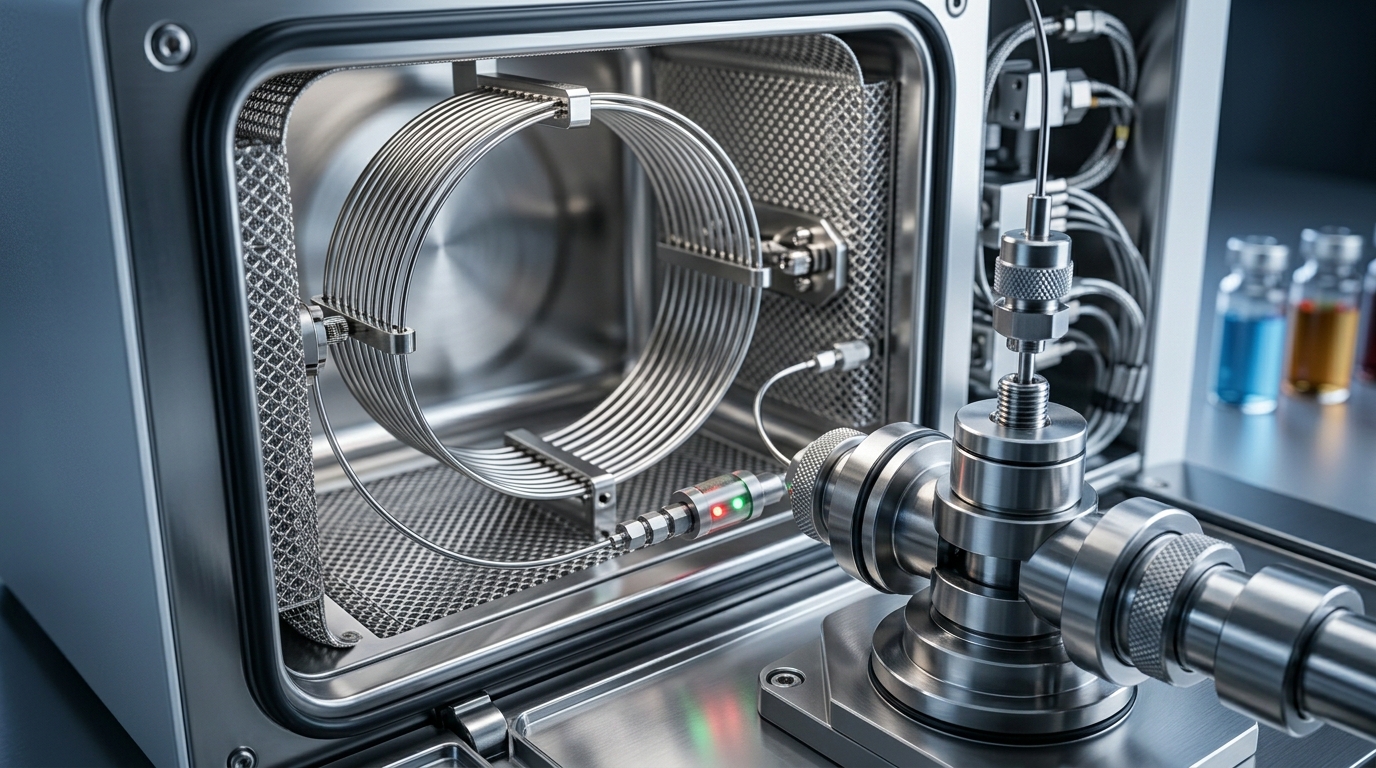
- Column and Oven: The column is the heart of the separation process. It is typically coiled inside an oven capable of precise Temperature Programming. Systematically increasing the temperature allows substances with high boiling points to separate and exit the column more efficiently.
- Detector: The downstream device that receives signals as compounds elute from the column. Popular industrial detectors include the Flame Ionization Detector (FID) for analyzing hydrocarbons, and the Thermal Conductivity Detector (TCD) for measuring gas thermal conductivity.
- Data System: Analytical software that converts electrical signals from the detector into a chromatogram, calculating the area under the curve to display the substance's concentration level.
Applications in Petrochemical and Environmental Industries
The high efficiency of the GC analyzer has led to its widespread application across multiple industries. In the Petrochemical industry, GC analyzers are used to analyze the composition of natural gas, crude oil, and polymer products to ensure raw materials meet stringent Quality Assurance standards.
In Environmental Engineering, this technology is vital for measuring Volatile Organic Compounds (VOCs) in the air, soil, or industrial wastewater. Precise measurements enable plants to control pollution emissions and remain within environmental safety standards.
Enhancing Efficiency with System Integration for Gas Analysis Systems
Installing high-precision analytical equipment alone may not be enough in the Industry 4.0 era. Integrating the GC analyzer into Process Automation systems is essential. System Integration allows an Online Gas Chromatograph to extract samples directly from gas pipelines into the continuous analysis cycle without human intervention.
Real-time concentration data is transmitted directly to a Distributed Control System (DCS) or SCADA, allowing engineers to evaluate process conditions, adjust mixture ratios, and promptly prevent machinery damage. For plants looking to increase measurement stability and precision, utilizing certified industrial gas analysis system design and installation services will ensure all analyzers work together perfectly. This reduces downtime and enhances the industry's long-term competitive edge.
Investing in deep analytical technology is not just a guarantee of product quality; it is the key to developing production processes that are safe, cost-effective, and environmentally sustainable.


