GC Instrument Buying Guide: Lab vs. Process GC Selection [2026]
In the petrochemical industry, refineries, and advanced analytical laboratories, the GC instrument or Gas Chromatograph is the cornerstone for separating and analyzing complex chemical compounds. Selecting this level of analytical instrumentation is not merely a price comparison; it is a technological investment that directly impacts product quality and production efficiency.
What is a GC Instrument?
A Gas Chromatograph (GC) is an analytical instrument that employs the principle of Gas Chromatography to separate volatile compounds. It relies on the differential migration of components through a column, driven by a carrier gas. Once separated, each component is measured by a detector and visualized as a chromatogram.
This instrument is critical for verifying purity, quantifying contaminants, and quality control. However, the internal mechanisms are complex. Buyers must understand the fundamental principles before defining specifications.
If you wish to understand the detailed mechanism of separation, mobile phases, and stationary phases, please read our in-depth pillar article: Unlocking the Secrets of Gas Chromatography.
Lab GC vs. Process GC: Crucial Differences
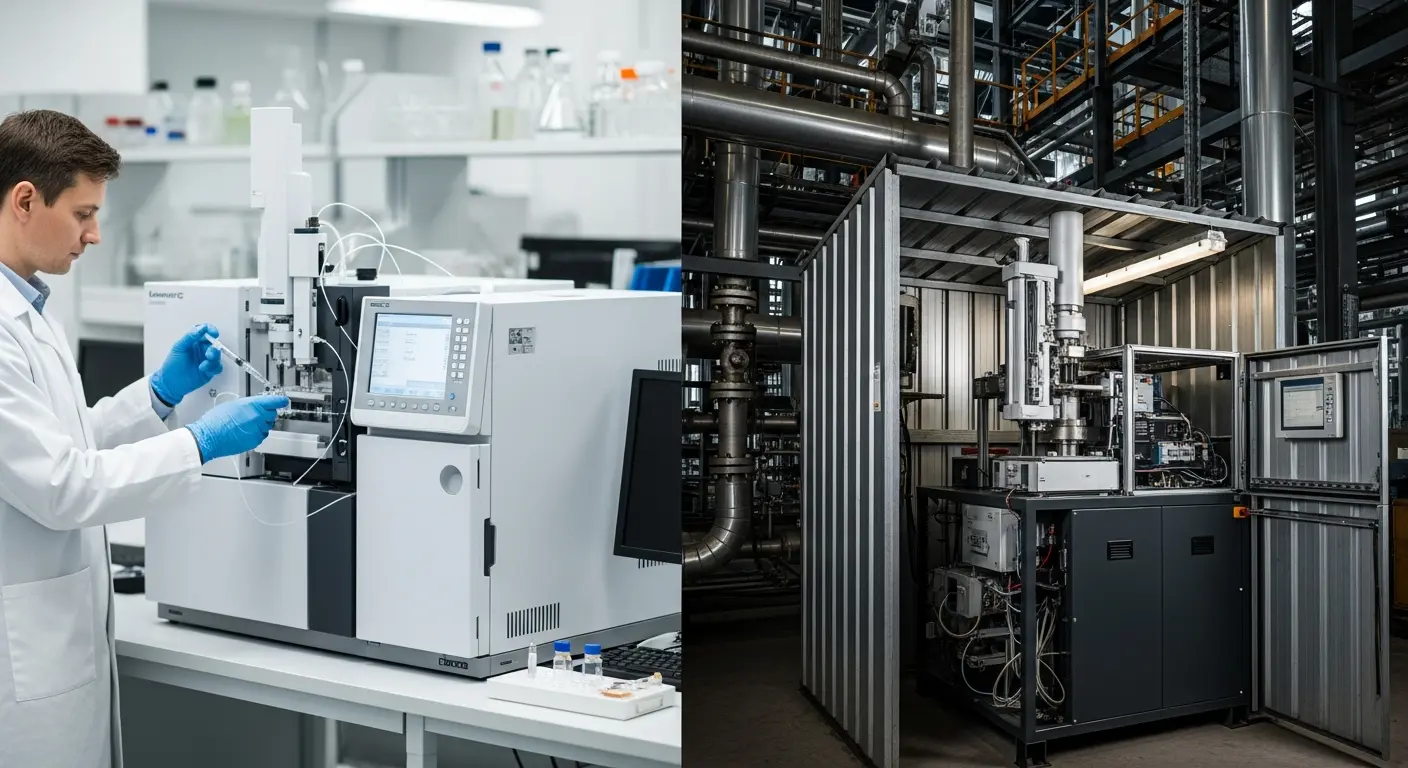
The first question a procurement officer or engineer must answer is, "Where will the instrument be installed?" Gas Analyzers in the GC category are divided into two main groups based on usage, with vastly different structures and price points.
Comparison Table: Lab GC vs. Process GC (Online GC)
| Feature | Lab GC (Laboratory Gas Chromatograph) | Process GC (Online GC / Industrial GC) |
|---|---|---|
| Location | Laboratory (Controlled temperature/humidity) | Plant Area, Hazardous Zones (requires shelter) |
| Analysis Mode | Batch Analysis (Manual injection or Auto-sampler) | Continuous/Real-time (Automatic sampling from process lines) |
| Flexibility | High (Methods, columns, and detectors can be changed) | Low (Designed for specific, fixed applications) |
| Construction | Standard Laboratory Grade | Rugged, Explosion Proof, High IP Rating |
| Starting Price | Moderate | High (Includes sampling system and shelter engineering) |
Lab GC is suitable for R&D or QC where samples vary, requiring frequent method adjustments. In contrast, Process GC (or Online GC) is designed for 24/7 unmanned operation, sending data directly to the Distributed Control System (DCS). This often requires a comprehensive Industrial Analyzer System.
5 Key Factors in Selecting a GC Instrument
To ensure you select a GC Machine that offers the best technical fit and ROI, consider these five factors:
1. Application and Sample Matrix
You must clearly define the sample matrix (gas or liquid) and the target analytes. Are you measuring % level or ppm level? This information dictates the column type and sample preparation system required.
2. Detector Type (The Heart of the System)
The detector converts chemical signals into electrical signals. Choosing the wrong type can lead to detection failure:
- FID (Flame Ionization Detector): Ideal for hydrocarbons (organic compounds). High sensitivity and wide linear range. The standard for petrochemicals.
- TCD (Thermal Conductivity Detector): A universal detector for any substance with thermal conductivity different from the carrier gas (including water and permanent gases). Less sensitive than FID.
- ECD (Electron Capture Detector): Specific for electronegative compounds like pesticides or halogenated substances.
- MS (Mass Spectrometry): Provides qualitative identification of compounds (most expensive).
If you only need simple leak detection or single-point monitoring without complex separation, consider learning about What is a Gas Sensor for a more cost-effective solution.
3. Throughput and Workload
If a lab analyzes 50-100 samples daily, a Lab GC with an Auto-sampler is mandatory. However, for a production process requiring analysis every 5 minutes for process control, a Process GC is the only viable option.
4. Automation and Integration Requirements
For Process GCs, installation involves more than just placing the unit. It requires signal integration (4-20mA, Modbus, Profibus) with the plant's control system. This requires specialized expertise. If you are unsure who can handle this, read about What is a System Integrator to help design a complete system.
5. Budget and Total Cost of Ownership (TCO)
Consider hidden costs such as carrier gases (Helium is becoming expensive; Hydrogen or Nitrogen might be alternatives), electricity, and consumables.
How Much Does a GC Cost? Pricing Factors
The price of a GC Instrument varies significantly based on specifications:
- Lab GC (Basic Configuration): Approximately 500,000 - 1,500,000 THB, depending on the detector and injection system.
- Lab GC (High-End / GC-MS): Can range from 2,000,000 to 5,000,000 THB.
- Process GC (Online): Prices typically start from 2,500,000 THB and go up to several million, as this includes the Sampling System, Explosion-proof Shelter, and Engineering costs.
ROI Consideration: Although Process GCs are expensive, if they prevent "giveaway" or off-spec production, the Return on Investment (ROI) can often be achieved in less than a year.
Maintaining Your GC for Longevity
To keep your Gas Chromatograph precise and durable, follow a strict Preventive Maintenance (PM) schedule:
- Daily/Weekly: Check carrier gas pressure and injection counts to replace Septa and Liners (for Lab GC).
- Monthly: Inspect moisture and oxygen traps in the gas lines. Saturation can permanently damage the column.
- Yearly: Clean detectors, perform leak checks, and calibrate against standard gases.
A common issue is "Column Bleed," or high background noise, often caused by column degradation or excessive temperatures. Proper maintenance mitigates this risk.
Frequently Asked Questions (FAQ)
Q1: Which carrier gas is best?
A1: It depends on the detector and budget. Helium is excellent but expensive. Hydrogen is fast and cheap but requires safety measures. Nitrogen is cheap but offers lower separation efficiency in some cases.
Q2: Is a refurbished GC worth it?
A2: It can be valuable for standard, non-complex lab applications, provided the detector and mainboard are verified and a warranty is included.
Q3: Can a Process GC be installed outdoors?
A3: Generally, no. It requires a shelter or enclosure with climate control to ensure stability and protect against weather conditions.
Q4: Is a UPS required for a GC?
A4: Yes, absolutely. A momentary power loss can shut down heating zones, potentially damaging the column or detector.
Q5: What is the difference between HPLC and GC?
A5: GC is for volatile, thermally stable compounds. HPLC is for non-volatile or thermally labile compounds (those that break down with heat).
Selecting a GC is a major technical decision. For more foundational information on the instrument's internal workings, revisit our main page: Unlocking the Secrets of Gas Chromatography.


